 Blackbird Archive
Review | White Stucco Black Wing, by Karen Kevorkian
Kevorkian packs a wallop with White Stucco Black Wing . Without sentimentality, she powerfully alludes to lost love and anguished yearning, refers dexterously to paintings without using them as mere illustration, and fiercely describes the death and burial of someone dear. Sobs of rage against the Iraqi war burst from the pages. No lightheartedness in these poems, no lullabies; the war cauterizes that part of her. Kevorkian's precise invocation of ordinary details—of nature, her surroundings, and people she knows or passes on the street—gives strength and passion to her work. Surprising syntax and unexpected imagery waken our awareness in such phrasings as "concrete torrents of wall," "Chiffon dress / smoothed blue," "tiny toenails of mice in the walls," at times adding striking shifts in lighting and perspective:
she snuffs the flashlight leans back as far as she can
looking up. It is something like looking down at L.A. on a clear night from a plane . . .
Swiftly rendered shock and grief permeate the war poems. She slashes into the newspaper to show the Iraqi war without elaboration. Her cool way of setting the daily facts of our war, fought on another continent, against the normality of everyday life in our own country creates a jolting comparison:
Let yourself go down into like a cave where men wait heads in hands for shelling
to stop . . .
Civilian body count 227 minimum 307 maximum only the first week.
Another brilliant cold day. Someone cutting grass . . .
Seemingly random details capture essences. She evokes, rather than describes, huge events and inescapable truths:
in the Land of White Noise. Everywhere a lawn being mowed. Women wearing
tiny American flags of
cubic zirconia . . .
Spread the pages. Who is crying today?
The flaunting of that suspect brand of patriotism has become a familiar political statement in favor of the war, making her sharply contrasting reference to the painful daily news that much more pointed.
In "Olive Lingering" we encounter the agony of watching a loved one die. Kevorkian does not fully reveal their relationship, yet we are allowed to sympathize fully with Olive and with those she leaves behind:
The sun beat down she hid in the house Olive is ready to pass watching the land that so flatly spreads We want her to and do not want it the low tract houses the green lawn its knifeblade sprout heat shivering mesquite Everybody waits for it tall cottonwoods that in spring fizz across lawns fluff shoring at the curb's edge Nobody wants it
In these sharply drawn contrasts, inside and outside, we are brought to recognize their dichotomy of feeling: the pain of losing her arrayed against their wish that she might die and end her misery.
"It Was the Idea of Them" expresses anguish suffered for an elusive love. Again Kevorkian does not dwell on the who, what, and why, but instead incises a description of raw emotion that causes us to feel pain in our unavoidable identification with her distress.
She lied. Their bodies not in her dreams. It was the idea of them unseeable
but present lives parallel nonintersected skittish prudence
"It Was the Idea of Them" gives the impression that the disillusioned narrator has removed to an isolated place in the woods. She not only employs imagery of dense forests and elusive deer, but she examines the very words she uses to deliver those images. The passage I quoted at the essay's beginning, comparing a starry sky during a walk in the woods with a night view of Los Angeles from the air, also comes from this long and richly varied work. Another section features a meditation on language:
Vocabulary: That which will not stay we must have
pray to make up words for.
Not a being with limbs stretching far and wide and having a certain size . (Because then
you'd have that white rump, disappearing.)
Rather than present everywhere in its entirety as spirit is
The epigraph for this poem, chosen from Maurice Blanchot, fits not only this work, but perhaps encompasses the direction of the book itself: That despair verged upon rapture.
Kevorkian often refers to painters and paintings and generally reveals a painterly sensibility. Before moving to Charlottesville, she worked for The Fine Arts Museums of San Francisco as an editor and distribution manager for art books. Earlier, she was married to a painter. This sensibility surfaces in, for example, "The Green Canal," a collage of seemingly disparate parts which glimpse events occurring in different cities, and which contains a revealing portrait of a Renaissance triptych:
Each end panel of the triptych shows a half room that closed conceals the crowned queen of heaven and in the corner the angel crouching with parroty wings bearing the message of a changed life.
If the end panels were closed as they never are they would meet to make a whole, a room before the virgin before the angel. In its windows far towers of another mythical city where pigeons struggle and preen their feathers released bits of smoke
Distant landscapes, often framed by windows, were an innovation in Renaissance painting. The scene described here, its pigeons and smoking chimneys observed through the Virgin's window, contrasts setting and details in the same way that Kevorkian does in her poetry: an apparently placid landscape is presented, seemingly untroubled by the earthshaking event occurring elsewhere.
One of my favorite pieces in this collection is her gentle rumination on "Lunch." For the moment, butter and chocolate, and rolls with ham, make a comforting respite from grief and horror:
Soft rolls with thin ham
butter without salt. The butter cookie called Little Scholar with gleaming chocolate
waxlike impression of an antique boy caught running.
I like to believe she means Sally Lunn rolls and country ham to keep the "antique boy" company—and giving some readers a temporary respite.
The book's title appears in the poem "El Camino Real." The street scene in California, as Kevorkian here describes it, evokes the dreaminess and lucidity of an American Golden Age illustration:
As in Maxfield Parrish, though he wasn't Californian. Still
that's what it feels like
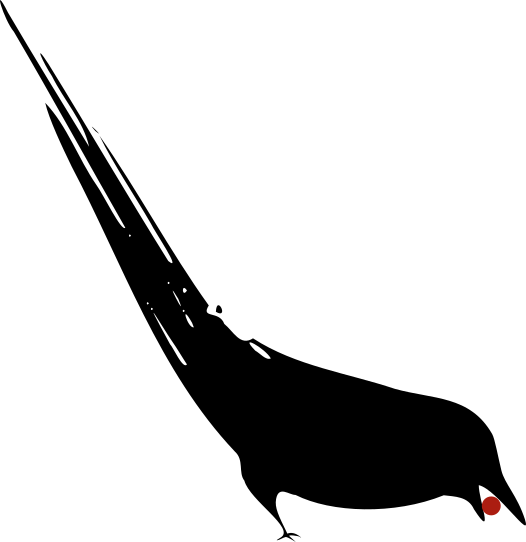
after dawn, or when the sun declines, when a shadow's black wing cuts white stucco, the street for a minute quiet, then a child cries, or a radio speaks the inky fluttering of a crow's wing
disappears over the white edge of a roof. Between buildings
palm trees effloresce, wide spary of green fronds, something processionally to bear. Ah, Aida
Maybe. Less grandly
new trees ringed with metal
staked, what's to come
The sharp contrast between black wing and white stucco symbolizes the jarring juxtapositions and harsh comparisons which emerge in poems throughout the book. Even the verb cuts stresses the starkness. Here, within a description of the softer times of day, the surreal peacefulness of dawn or dusk, she sets the vaguely ominous image of the crow. To further that eerie feeling, the palm trees and the historic street name (The Royal Road), with its invocation of the processes of European colonization, lead us to the victory procession in Verdi's tragic opera. That imagery, juxtaposed with the staked trees of the future and their final question, creates a doleful, foreboding picture.
In "Escuela and Rengstorff," names of streets which intersect with El Camino Real, Kevorkian compares the modern street with the same road in 1776, named by the Spanish who rode through on their way to settle San Francisco. The party of Lieutenant Colonel Juan Bautista de Anza encountered a terribly frightened Indian who held out to them "his bunch of grass / as if by this present he hoped to save his life ." This study in contrasts continues into the present, where "you press a button on a pole" in order to cross the street now, and ending with another study in ironic contrasts, examining
The way people will stop, turn,
help a blind woman or man, flash of dark
hands held out, feeling, something to shrug away from.
Kevorkian's poems give evidence of their having been made with both adventurous creativity and responsible care. Characteristically, "Tinged with Red Neon Clouds Drift in from the Coast" contains examples of Kevorkian's rich use of metaphor: "lichen scabs bark," rocks are "fat," tree roots "exotic," rain falls in "morse code," leaves flutter "with importance." She also gives care to the appearance of the poem on the page. Irregularity of punctuation and syntax are used with striking effect. In "Her Clothes Weren't Quite Right for the New Town," Kevorkian links a meditation on a rainy afternoon with a woman deciding what to wear (the epigraph from Cesar Vallejo is itself a study in intriguing contrasts: "The afternoon is pleasant. Why shouldn't it be? / It is wearing grace and pain; it is dressed like a woman.") and it ends with lines which seem, like the rain, like the woman's dress, to go on flowing:
Cocoon? The task of opening all the boxes on the floor. All the sleeves inside
flowing out onto
Karen Kevorkian's craftsmanship is meticulous. Never a word, nor comma—nor lack of comma—is unintended. Spare, cubistic poems plumb deep emotional ranges. Intensities of feeling are set among mundane details of dailiness as well as elegant images of nature. The beauty of her art vivifies through its many contrasts both the anguish of lost love and the horror of our war in Iraq and mysteriously provides links between them. This small volume keeps pulling me back with its density of meaning and the heft of its exquisite creations.
