 Blackbird Archive
“Everywhere in the Kingdom” 1918 Suite
Everywhere in the Kingdom
The 1918 influenza pandemic left far less cultural and literary evidence in its wake than one might expect given the Center for Disease Control’s contemporary (and perhaps conservative) estimate of fifty million dead worldwide. Despite overwhelming loss of life and the subsequent impact to global communities (with one-third of the world’s population said to have been infected), well-known literary treatments in English are scarce. We are aware of Katherine Ann Porter’s Pale Horse, Pale Rider (1939) as mentioned in Brian Bouldrey's essay in this suite, and Horton Foote's 1979 play, 1918 , from his Orphans’ Home Cycle , which we quote here in an opening epigraph.
Ellen Bryant Voigt’s book-length sonnet sequence Kyrie remains the dominant contemporary treatment of the 1918 influenza pandemic. She published the book in 1995, mindful, as well, of the epidemic of her historical moment. (The book appeared the same year that the CDC reported 500,000 cases of AIDS in the United States.) We lead with Voigt’s work and voice in this suite: in Poetry we offer a selection of eight poems from Kyrie and in Gallery a portion of a 1996 video of Voigt reading from the book. A conversation in which she discusses the making of Kyrie was first published by Blackbird in 2007; republished here in Nonfiction is the relevant transcribed portion of that discussion under a title lifted from Voigt’s response to a question she echoes back before answering, “What do poems do? They set truth to music.”
A serendipitous conversation on social media brought us Brian Bouldrey’s essay, “One Singer to Mourn,” in which he examines the WWI-era letters of his family. Bouldrey examines an uncle’s service in WWI, the influenza pandemic, and family history in light of Bouldrey’s life as a person living with HIV.
The Spanish flu targeted specifically, if not exclusively, young adults between the ages of twenty and forty. Your basic workforce, adults with parents still living. While, as the cultural critic Fran Lebowitz pointed out in “On Race and Racism” that “genocides are like snowflakes, each one unique, no two alike,” the young men from twenty to forty who fell to AIDS left a similar hole in the population. The world became a desolate landscape of bereft parents, orphans, and widowed spouses.
Though we searched the digital archives with low expectations for uncovering undiscovered literary texts published closer to the time of the 1918 pandemic, we hoped at least to find, perhaps, cultural or artistic responses.
Blackbird intern Megan Hannifin (spring 2018) brought to our attention the sculptor Chana Orloff, who lost her husband, the Polish poet Ary Justman, to influenza in 1919. We present here a published album of woodcuts depicting nine women who surrounded her during this time, and of her infant son; the final image in the album is the artist’s self-portrait. We also include a text selection by Ary Justman from the collaborative Réflexions Poétiques (SIC Editions, 1916), a book containing poems by Justman and images by Orloff.
She tip-toed to the bed and listened to his fast breathing, and, laying her small white finger on the pulse in front of his ear, counted the rapid heart beats while keeping her eyes fixed on her wrist watch. She shook the thermometer down and again placed it in his mouth and he went to sleep before the time elapsed to remove it, which she did gently, again stepping to the table and holding it under the reading lamp. It read the same as before—105.
Though the chapter from “First Case” is the lesser of the two texts by Anthony, we include it here for the brief portrait it gives of a solitary village doctor working house calls in a 1920s vehicle on damaged dirt roads during the height of the pandemic.
Although The Medical Pickwick does not distinguish “Gerzat” from “First Case” in terms of genre, chapter twelve of “Gerzat”—“The Spanish Influenza”—is a detailed and compelling first-person narrative:
I had difficulty with some of the officers. They were inexperienced with medical matters and had the interest of the men at heart and kept insisting that I do the impossible. . . . It never occurred to them, however, that I had an interest in the thing, too; that I had no desire to see the men sick: that I was troubled with the seriousness of affairs and every death grieved me . . . that I wished for—oh, how I wished for—something that would cure or prevent the disease, but being, as they were not, informed as to the nature of the infection, the pathology of the tissues and the course of the disease, I knew only too well that such hope was beyond human power.
Anthony served in WWI as a captain in the medical detachment of the 337th Field Artillery Unit, 88th Divison. Given his military service, we are certainly tempted to read the account of caring for men afflicted with “the Spanish flu” in a field hospital in Gerzat, France as nonfiction—or thinly veiled nonfiction—which also frequently uses the device of remembered or recreated dialogue.
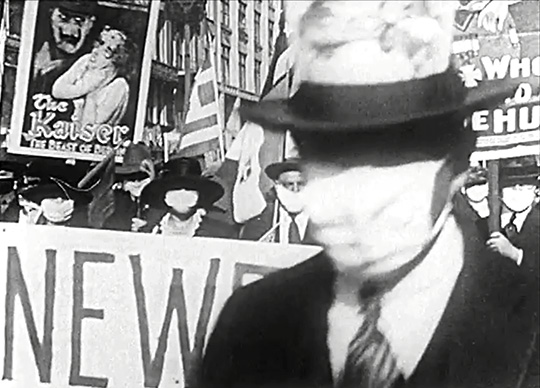
Finally we offer, in our “time capsule,” three minutes of film footage from the Prelinger Archives that show soldiers on parade in 1918. Both the parade marchers, and the public watching along the streets, are weaing influenza masks, which were, in some localities, required under penalty of law.