 Blackbird Archive
“The Rapping” | from The House in Hydesville by Dan O'Brien
The Rapping
The Fox Family
A small one-and-a-half story frame house in Hydesville, New York, at the crossroads of Hydesville and Parker Roads, beside the Ganargua River.
The first act (from which the first two scenes below are excerpted) begins with the Fox family’s arrival at the Hydesville house on December 11, 1847, and continues in the months leading up to March 31, 1848.
The second act takes place over the course of a day, a night, and a morning, a little over a month later in early May, 1848.
Scenes occur in the different rooms on the house’s ground floor, and one scene takes place outside the back door, so the house might revolve on stage, or transform in some other, simpler way. A distinctly physical, cramped, oppressive sense of the house is what’s important here.
Also, a sense of simultaneity in the house is intended, in that characters not directly involved in a scene in the kitchen, for example, might be visible sleeping, resting, reading, or listening in another room, in the dark or not.
The actors playing Leah, Lizzie, and David all have considerable offstage time; they might act as Foley artists, as it were, creating the various haunting sounds called for throughout the script. The spirit, and the presence of the spirit via sound, is central to the play. Regardless of its agency, this rapping is a human sound.
(Two girls speaking:)
CATHIE Mr. Splitfoot?
MAGGIE —Don’t say that.
CATHIE Why not?
MAGGIE What if it’s true?
CATHIE Mr. Splitfoot? Do as I do:
(CATHIE claps her hands three times. Pause.
The sound of someone rapping, as if their knuckles on wood, in response three times.
The girls cry out.
Rapping continues: staccato, eerily, growing less mysterious, as if someone’s knocking at the door . . . )
(Lights rise on the inside of a kitchen: dreary, dark, empty but for a table and some chairs.
Mid-afternoon in mid-December.
Everything’s covered in what appear to be filthy bed sheets.
The floor is bare: a warped, patched, planked floor. Outside the sun off snow is near blinding but fails to brighten this room.
Someone’s knocking at the kitchen door.)
CATHIE (outside) —Just go in!
(Slowly the door opens, and MAGGIE, 14, attractive but plain, steps inside in an old, ill-fitting coat, looking around disappointedly:)
MAGGIE (to herself) . . . This is the house?
(Enter CATHIE behind her, her sister: 11, reed-thin, birdlike; there’s something electric, ethereal, almost frightening about her.
She strides past MAGGIE and circles the room.)
CATHIE Hello?
MAGGIE There’s no one in here, Cathie . . .
CATHIE Who’s here?
MAGGIE Nobody, Cathie—it’s empty.
CATHIE It’s not: I saw a face.
MAGGIE Where?
CATHIE At that window there. Looking out at me . . .
MAGGIE That was only your own reflection you saw . . .
CATHIE These windows are filthy. —Look at my hands!
MAGGIE We’ll clean them then—
CATHIE Hello? —Echo!
MAGGIE Stop it or they’ll hear you!
CATHIE So? —What’s that sound?
MAGGIE Where?
CATHIE There’s a fly in here, at that window . . . that’s strange, in winter . . . maybe something’s dead in here?
(CATHIE sniffs the air.)
MAGGIE (looking) It’s not a fly, it’s a moth . . .
CATHIE I smell peppermint. Do you?
(CATHIE smiles. MAGGIE sniffs the air now too.)
MAGGIE No.
CATHIE “No.” —This won’t do at all. —It’s much too small for us!
MAGGIE We’ve lived in smaller before . . .
CATHIE We’ll go home today . . .
MAGGIE This is our home, Cathie . . . for now.
(CATHIE peers round the door, into the pantry.)
MAGGIE (cont’d.) It’s only for the winter they said . . .
CATHIE I’m not sleeping in that pantry. I can tell you that much.
MAGGIE Why not?
CATHIE —It’s the pantry!
MAGGIE We’ll sleep in the bedroom then.
CATHIE There’s only one room, in front. — They’ll sleep in there.
MARGARET (outside) —Girls?
(CATHIE grabs MAGGIE’s hand and they run through the open door—into the pantry.
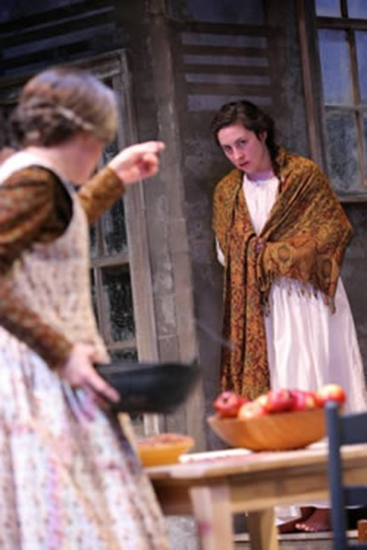
As MARGARET enters, their mother, 51: stout, grim, voluble, silly, it would seem. Her hair is a mess of white.
She carries an old rocking chair, loaded up with supplies, and balanced there on top: a bushel of bright red apples.
She drops the chair—it rocks, and a few things spill out across the floor, some apples . . . Winded, but with great determination, she begins unpacking, sweeping the dust-filled sheets off of the disappointing furniture.
There’s something uncannily childlike in her voice:)
MARGARET (cont’d.) Where are you girls hiding now? You know your father needs our help outside, carrying all our things down into that cellar . . . can’t you hear him now? He’s opened up the cellar door—on my word! This house is well kept up . . . have you seen? They’ve left some fresh linens over all the things, their furniture, it’s warm in here, such bright windows! And cozy, yes, with a view of the river and snow beyond and the sun and smell of peppermint somehow . . . this will be a very good home, for the time being, don’t you think?
(She kills a moth on the wall with her hand. Wipes her hand off on her coat, cheerfully.)
MARGARET (cont’d.) —Girls? There’s a butterfly in here!
(Now she hears a thump or rustle—doesn’t know where from. She creeps about, as if a girl herself, looking for them.)
MARGARET (cont’d.) . . . Margaretta? Catherine? —Don’t you play games with your mother now!
(She’s about to peer into the pantry when—)
CATHIE —Help us Mother, please!
(CATHIE shrieks, MAGGIE squeals in sympathy and excitement, as both girls burst from the pantry and spill out around the room.)
MARGARET —Oh!
(Their mother falls back in her chair, heaving, frightened, delighted, rocking . . .
MAGGIE stands next to her mother, patting her forearm gingerly, as CATHIE circles the room again:)
MAGGIE We’re sorry, Mother . . .
CATHIE (mimicking) “We’re sorry, Mother” . . .
MARGARET (to Cathie) —I knew where you were this whole time!
CATHIE You were scared! I could tell!
MARGARET You mustn’t do that! You mustn’t scare your mother like that! —I could belt you for that one, you know!
CATHIE But you won’t.
We’re not sleeping in that room, Mother, by the way.
MARGARET (standing up) Oh, are we not now?
CATHIE No.
MARGARET And why, may I ask our little princess . . . ?
MAGGIE She wants to sleep in the other room with you. With all of us, together.
CATHIE You want that too.
MAGGIE Why would I?
MARGARET We won’t be doing that no . . .
CATHIE Why not?
MAGGIE Why do you want that so badly, Cathie?
MARGARET Yes, why, Catherine?
CATHIE Other families do it.
MARGARET Not Methodist families . . .
CATHIE We used to sleep together. We’ve done it before.
MARGARET We don’t have to anymore. Not out here.
CATHIE “In the sticks” . . .
MARGARET You watch your tongue, young lady.
CATHIE I can’t: see, my tongue’s too short.
(She sticks out her tongue at her mother while speaking:)
Can you watch my tongue? What’s it saying?
(MARGARET has busied herself unpacking.)
MARGARET . . . Your father likes it here, all this quiet . . . he likes the quiet, don’t you? I like the quiet too . . . though not so much as others . . . don’t you like it out here, so quiet, all the time? And the snow in all ways, all around us . . . some people like the quiet, and others they do not. —Your older siblings, now, they all like quiet . . . very much so, like their father does—
MAGGIE I like the quiet too, I think.
CATHIE You don’t.
MAGGIE —I might!
CATHIE You’re quiet, but you don’t like it.
—I’m not going to sleep in that room, Mother. And nothing you can do or say will make me!
(Pause. Mother and daughter square off.)
MARGARET Go ask your father then.
CATHIE “Go ask your father then.”
MARGARET You’re a very good mimic. You ought to be an actress.
CATHIE “All actresses are whores.”
MARGARET —Filth!
CATHIE Father says that: father says filth sometimes!
MARGARET You watch your tongue, young lady.
CATHIE You watch it! —I can talk without moving my lips, see?
MAGGIE No you can’t, Cathie . . .
CATHIE You’re not even watching!
Mother, can’t we all sleep together in the very same room tonight, please?
MAGGIE It’s only for the winter . . .
(CATHIE sticks her tongue out at her sister.)
MARGARET You listen to your sister, she’s got more sense than you. One day you’ll find yourself alone in this world, and then all you’ll have is family . . . and Maggie here will save you.
Now help me with these things. Be careful, they are delicate . . .
(MAGGIE helps: Unpacking chipped cups and saucers, some glasses and well-worn plates, unwrapping the newspaper from around them . . .
CATHIE sulks.)
MAGGIE . . . We could sleep in the attic, could we not?
CATHIE “Could we not?”
MARGARET The attic is for storage. You mustn’t play up there. This house is much too small, for everything we own . . . we’ve left a lot in town. But we’ve brought so much with us here! Too much for this small house . . . so we’ll have to leave it all unpacked, upstairs. For the time being. —Don’t you think that’s best? The attic, until springtime comes and we can move again . . .
CATHIE What about the cellar?
MARGARET You mustn’t play down there either. Or your father will get cross.
MAGGIE She means for sleeping, in the cellar.
MARGARET Don’t be stupid! You can’t sleep underground.
CATHIE Ghosts do.
(Short pause.)
MARGARET You’re not a ghost you’re a girl.
(MARGARET continues to unpack.)
MARGARET (cont’d.) My mother saw ghosts. You never met her. —In another age, she’d have been thought a witch, I’m sure of it.
CATHIE We all know about your mother, Mother . . .
MARGARET I dreamed of her last night. I don’t know why that is. She had that gift, of second sight. Or future sight, as the Scots say. —I wonder what’s the difference?
MAGGIE (quietly) Who knows?
CATHIE “Who knows.”
MARGARET Who knows. That’s right. She came from France originally. She was a Huguenot, and prosecuted—
MAGGIE “Persecuted,” Mother.
MARGARET I’m sure she was that too . . . she would have these premonitions . . . where she would rise up out of her bed, walk out into the road—where she’d swear she was seeing a funeral procession, right there in front of her eyes! passing by our home . . . and she’d follow them down to the graveyard . . . where she’d cry, alone, watching the phantom burial occur.
My father used always to go find her, somewhere in that very large cemetery, in Rockland, late at night. —And sometimes he’d find her elsewhere, walking the streets, shouting out at neighbors’ homes the names of those she knew would pass away that night.
He’d have to quiet her sometimes. He’d have to drag her home. He’d have to lock her up, sometimes . . .
But always—she was correct! In the morning, whomsoever she had seen in her vision would be stiff. As wood.
(She knocks on wood, crosses herself.
CATHIE shivers.)
MARGARET (cont’d.) Are you cold, dear? That’s natural, after a story like that. —You’re a Sensitive! That’s what you are. My mother was one too. You’ve been that way since birth. We’ll get that stove working soon, you’ll see . . .
CATHIE It’s cold here.
(She steps or leans:)
But not here.
MARGARET (pleasantly) Yes now why do you think that is?
MAGGIE Who knows?
CATHIE “Who knows?”
MARGARET I don’t think it’s cold. Do you? You have to keep yourself moving. You’re much too thin. You don’t see Maggie shivering, do you?
CATHIE I think that it’s the river . . .
MARGARET What’s the river? All this damp?
MAGGIE It’s a creek.
CATHIE What’s its name again?
MAGGIE It’s called Mud Creek by some . . .
CATHIE (recalling; as if mesmerized) “The Gargantuan”—
MAGGIE But its real name is the Ganargua.
CATHIE Sounds like a throat’s been cut.
MARGARET —Catherine Fox!
(MARGARET has slammed a bowl, or a stack of plates, down to the table. They’ve made a clatter, but nothing’s broken.)
MARGARET (cont’d.) . . . Go outside and help your father please.
CATHIE (resolutely) No.
MARGARET . . . I don’t know why you’re all so afraid of him . . . if you think he’s so bad then you ought to have met my father . . . my father didn’t like your father—not one bit! I come from good stock . . . we had to run away, and it was like a novel. —Now, my father—
(CATHIE takes an apple.)
MARGARET (cont’d.) Is that him I hear downstairs? —He must have opened up the cellar door, from the outside, he’s storing up the apples, amongst other things. —It was so nice of the Posts to give us their apples, don’t you think? What do you think of the Posts, are they kind? —I like apples when they are cold, don’t you?
(CATHIE bites into her apple now.)
MAGGIE I’ll help you help Father, Cathie . . .
CATHIE I can’t go. I break things.
MARGARET That’s true. Why is that? Your grandmother was just like that!
CATHIE My hands are too small, I drop things. See? You go, Maggie. You’ve got big hands, for a girl . . .
(Pause. MAGGIE looks at her hands, almost suspiciously . . .
She goes out: snow-bright white out there.
MARGARET Isn’t that so? A very cold, crisp apple? In the very dead of night? I mean winter . . . makes one feel hopeful . . . I feel hopeful naturally. Don’t you?
CATHIE Can’t we go home now please, Momma?
MARGARET We’ve only just arrived!
CATHIE When can we go, then?
MARGARET When the winter’s done.
CATHIE In May?
MARGARET If we’re lucky it will be April . . .
CATHIE “This winter lasts the whole life long” . . .
MARGARET Who said that, some poet?
CATHIE It just came into my head . . .
(MARGARET continues to unpack.)
MARGARET Help me, Cathie, help your mother please . . . You won’t drop them now with your hands all sticky from that apple . . .
(CATHIE helps, reluctantly: Unpacking more glasses, cups, saucers, etc.; dusting them off, lining them up on the tabletop in order of size and utility . . .
It’s not a very impressive collection.
MARGARET moves to the stove, opens it, cleaning ash, on her knees with her head and hands inside.
After a moment:)
CATHIE Why did Poppa sell our furniture? . . . I saw him in the street.
(MARGARET rises from the stove, looks at her daughter as if startled, then confused . . . Some ash on her face.
She turns away again, bustling about the kitchen, opening up drawers and cabinets, slapping them out with a rag.)
MARGARET It was good of the Posts to give us those apples. Don’t you think? After all? —And so many! They are kind souls, if they are Quakers . . . and Hicksites to boot. —Even though they think so much of themselves sometimes, their knowledge . . . even if they think they know God, or that Negroes are like normal men—
(A teacup from the table next to Cathie appears to fall, as if by itself—
CATHIE catches it.)
MARGARET (cont’d.) —Careful!
CATHIE Sorry, Momma. It was an accident. Almost.
As CATHIE sets the teacup carefully on the tabletop again.)
CATHIE (cont’d.) Momma?
MARGARET You talk too much, you know that?
CATHIE Mrs. Weekman had help. Had she not?
MARGARET Of course. Mrs. Weekman. Who’s she?
CATHIE The family that lived here before us. Before the family before. A renter, like we are.
MARGARET Do I know her?
CATHIE She’s alive now still. In Macedon. She had help with her four children, did she not?
MARGARET I presume so.
CATHIE She saw a ghost here once.
(MARGARET stops working.)
MARGARET Mrs. Weekman did . . . ?
CATHIE The help did. Jane Lape was her name. Still is, she’s alive now too, I think.
This was only last year this all occurred. Or the year before that. —Jane Lape told Mr. Hyde’s boy who told me . . . that Jane Lape saw a man.
MARGARET In this house?
CATHIE In that pantry. At the top of the stairs down to the cellar.
(MARGARET sits down, across the table from her daughter.
She may even reach out and touch her daughter’s hand—a glancing numb touch.)
MARGARET . . . What did he look like? Did she say?
CATHIE Tall, and thin . . . he wore gray pants and a long black coat, black hat, wide brim—you could scarcely see his face! . . . He held this bag in his hands, a sack full of bottles of—very small vials of scent . . . you could smell the peppermint, Jane said. You could hear the bottles clinking in the bag, like chimes . . .
MARGARET Like chimes? . . . She told all this to you?
CATHIE She told Mr. Hyde’s boy, who told me: the man stood in the doorway, and watched her.
MARGARET And what did he say?
CATHIE Nothing.
MARGARET Why not?
CATHIE His throat been cut.
(MARGARET gasps. She crosses herself. Thrilled:)
MARGARET —You mustn’t tell this to anyone, ever!
(Footsteps come knocking up from the cellar, into the pantry. MARGARET and CATHIE start mildly in surprise at:
JOHN Fox, who enters the kitchen from the pantry.
He stands in the doorway, soft black hat on head, a dirty, deflated sack in his hands . . . he looks at his wife and daughter.
He’s an old man almost, late 50s, not aging well. His face is pale, gaunt, vacant, but he’s still powerfully built: the arms and shoulders and hands of a blacksmith.
He doesn’t say a word. He’s holding the empty bag.)
JOHN Help your sister.
CATHIE Yes, sir—
JOHN And I’ll brook no more complaints from you. —Understand?
CATHIE Yes, sir.
MARGARET —Complaints, John?
JOHN I heard everything. I was downstairs. (Pause.) Outside. Go.
(JOHN drops the empty sack to the table, as—
CATHIE exits. But she grabs another apple from the bushel, deftly, without being seen.
She’s gone.
MARGARET continues to unpack and clean and stow, nervously, as if cheerful . . .
JOHN sits down at the table.
He looks around him at the small, dark room, the dirty windows, the blinding white light outside . . .
He stares ahead into nothing.
MARGARET, unpacking, unwrapping, glances at the empty sack.)
MARGARET Have you stored all the apples in the cellar?
(He doesn’t answer.)
MARGARET (cont’d.) It was kind of the Posts—
JOHN Can’t you ever shut your mouth?
(She continues to work, busily, seemingly unperturbed.
In one of the upstage windows we see the top of CATHIE’s head, outside, as if she’s standing on something unsteady, a rock or log; now we see her face, peering at her parents through the dirty glass . . .
MAGGIE’s face appears in the other window, watching much more furtively, guiltily. She’s watching her sister at the other window as much as she’s watching her parents inside. Both their faces appear warped in the glass.
MARGARET finds a box of matches, moves to the stove and strikes a match, bends to the grate. JOHN stares at the back of her.
A knocking sound is heard, but not from either window—a loud report. The parents respond with some surprise, if not alarm, as the girls duck down out of view.
Lights out.)
MARGARET —Oh!
CATHIE Ask him a question, Momma.
MARGARET Ask him?
CATHIE Anything you’ve always wanted to ask a soul . . .
MARGARET Anything?
MAGGIE Something only a spirit would know, Momma.
CATHIE A secret.
MARGARET Secret?
CATHIE Only a spirit would know . . .
MARGARET . . . How many children have I, Spirit?
(Slowly, we hear six knocks. The sound of MARGARET gasping.
Then: a seventh knock.)
MAGGIE There aren’t seven of us.
(Short pause.)
. . . Momma?
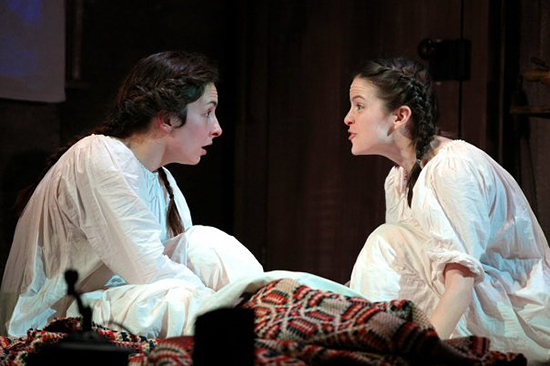
(Lights up on the sisters in their one small bed together. It’s the middle of the night.
No candlelight, just moonlight off snow and the black shapes of branches in the room’s one, tall, narrow window.
The walls and floor are bare.)
CATHIE Margaretta. Margaret. Maggie.
MAGGIE I’m sleeping.
CATHIE No you’re not.
MAGGIE Not now . . .
CATHIE Listen:
(They listen.)
MAGGIE . . . What is it?
CATHIE Somebody’s downstairs, in the cellar.
MAGGIE No there isn’t . . .
CATHIE —There is!
MAGGIE —There’s no one down there, Cathie!
CATHIE I hear him. Shuffling.
MAGGIE Shuffling?
CATHIE Like an animal does . . .
MAGGIE It’s only Father.
CATHIE Doing what do you suppose?
MAGGIE Whatever it is he does down there.
CATHIE What does he do? Do you know? —I’ve gone down there—
MAGGIE You shouldn’t, Cathie—
CATHIE You’ve gone down there too: I’ve seen you.
(A pause.)
CATHIE (cont’d.) And I found the bottles . . .
Do you remember Jane Lape said the ghost had been a pedlar, in life? That’s why he held that bag in his hands, full of bottles . . .
MAGGIE Those were perfume bottles—
CATHIE The ones I found were empty. The glasses were all green. Underneath an old stinking tarp . . . The labels had all been scratched away.
—And when I held them to my nose they smelled like peppermint.
(Pause.)
MAGGIE It’s the fields.
CATHIE What’s the fields?
MAGGIE All these fields around here are full of peppermint, in the spring. You’ll see. That’s what’s farmed out here mainly.
CATHIE It’s not springtime now.
MAGGIE It will be soon. You’ll see.
CATHIE “The snow is deep, and falling ever faster” . . .
MAGGIE Who said that?
CATHIE I don’t know. Some poet.
(CATHIE starts with fear.)
MAGGIE It’s nobody, Cathie—
CATHIE —It’s Nobodaddy!
MAGGIE Who’s that?
CATHIE Just another name for Splitfoot.
MAGGIE Who’s Splitfoot?
CATHIE You know . . .
MAGGIE You mustn’t say those names—!
CATHIE You mustn’t say mustn’t because it makes you sound like Mother! Mother’s crazy!
MAGGIE That’s not true!
CATHIE She can’t stop talking about nothing! That’s crazy!
(A quiet, single knock, from somewhere down below. They both hear it this time.)
CATHIE (cont’d.) You pretend like you don’t hear it but you do . . .
MAGGIE It’s Father, I know it is—
CATHIE It’s not!
MAGGIE How do you know?
CATHIE If he went down there while we were sleeping we would’ve seen him pass through. He would’ve stepped on us.
MAGGIE He got in from the outside then. Through the cellar door.
CATHIE If you listen you can hear him breathing, through the wall . . . he’s asleep, on the other side, with Momma.
(Another knock, somewhat louder.)
CATHIE (cont’d.) He’s walking up the stairs now—
MAGGIE It’s the house.
CATHIE How the house?
MAGGIE It’s an old house—houses make sounds—
(Another knock, louder. Like a footfall on the cellar stairs.)
MAGGIE (cont’d.) —It’s all in your imagination!
CATHIE Are we imagining this together then?
(MAGGIE fumbles for her box of matches, strikes a match—about to light the candle:)
CATHIE (cont’d.) —Don’t!
(CATHIE waves or claps or blows the match out.)
CATHIE (cont’d.) You’ll scare him off that way . . .
(Another knock, louder.
CATHIE gets out of bed.)
CATHIE (cont’d.) Maybe he’s one of those men, who go fishing in the creek at night . . .
MAGGIE A man?
CATHIE Who chop holes in the ice with their axes and saws . . .
MAGGIE It’s too late for night-fishing, Cathie . . .
CATHIE That’s why it’s called night-fishing!
MAGGIE —It’s nature I bet.
CATHIE What kind?
MAGGIE Outside. Just sounds like it’s in. The trees, there’s so many of them overhanging the house—!
CATHIE Trees don’t walk around the cellar, up stairs.
MAGGIE Trees have branches.
CATHIE You mean arms that hold things . . . like axes!
MAGGIE —Stop it!
CATHIE Because it is a man. I can feel it . . .
One of those fishermen from the Ganargua . . . when all his friends have gone home, to their families . . . this one has nowhere to go. He watches us, through that window there . . .
And he’s crept into our house, through the cellar door—
MAGGIE What for?
CATHIE What all men want: to kill us.
(They listen.)
MAGGIE It’s rats, probably.
CATHIE —We have rats?
MAGGIE I don’t know, maybe.
CATHIE That’s what Mrs. Bell told Lucretia.
MAGGIE Who’s Mrs. Bell?
CATHIE Who lived here before us. Before the Weekmans too, long time ago, maybe four, five years . . . Nobody likes the Bells around here. I don’t know why that is. They live in Lyons now.
MAGGIE Who’s Lucretia?
CATHIE Pulver. The girl who told the girl who worked for the Weekmans, Jane Lape, after the Bells, who talked to Mr. Hyde’s boy, who told me:
How one night Lucretia Pulver went down to the cellar for some things, some jam maybe, and she fell down! The dirt was so loose and choppy down there . . . like someone been digging . . . she fell down on her knees. She came upstairs and told Mrs. Bell in the kitchen who said those was only just rat holes the rats had made. She gave Lucretia Pulver a spoonful of jam . . .
MAGGIE Why . . . ?
CATHIE And before that—Lucretia said she saw the pedlar here the night he disappeared, with his bag full of perfumes and buttons and ribbons and thimbles . . . they asked him to spend the night, if he cared to. Then they sent Lucretia away—for three whole days! And when she came back . . . Mrs. Bell wore that pedlar’s thimble on her finger.
MAGGIE His thimble?
CATHIE Made of silver . . . and there were those rat holes down below!
(Silence. They listen.
A long pause . . . Is he gone?
A very loud knock, this time as if coming from the other side of the door.)
MAGGIE —It’s nobody!
CATHIE —It’s Nobodaddy!
(Another knock: twice.)
MAGGIE —Don’t open it, Cathie! Please!
CATHIE You believe in him now?
(Pause. CATHIE opens the cellar door.)
MAGGIE Who is it? Who’s there?
(CATHIE turns to her sister, smiling:)
CATHIE Nobody.
(Blackout.)